

Publishing in Scopus Q1–Q2 journals requires more than strong research output. Even high-quality studies are often rejected due to language issues, unclear expression, and avoidable grammatical errors. Proofreading plays a crucial role in ensuring that a manuscript communicates ideas clearly, professionally, and in line with international academic standards.
This guide provides essential proofreading tips to help researchers improve manuscript quality and increase acceptance chances in top-tier journals.
Focus on clarity over complexity
Academic writing should strictly communicate ideas clearly. Reviewers read many of the manuscripts and respond to the well-structured and precise sentences. Language quality is the first signal that is evaluated by the editors. Use simple, precise sentences that mainly aim at one idea, eliminate unnecessary jargon words and remove phrases like “it can be observed that”
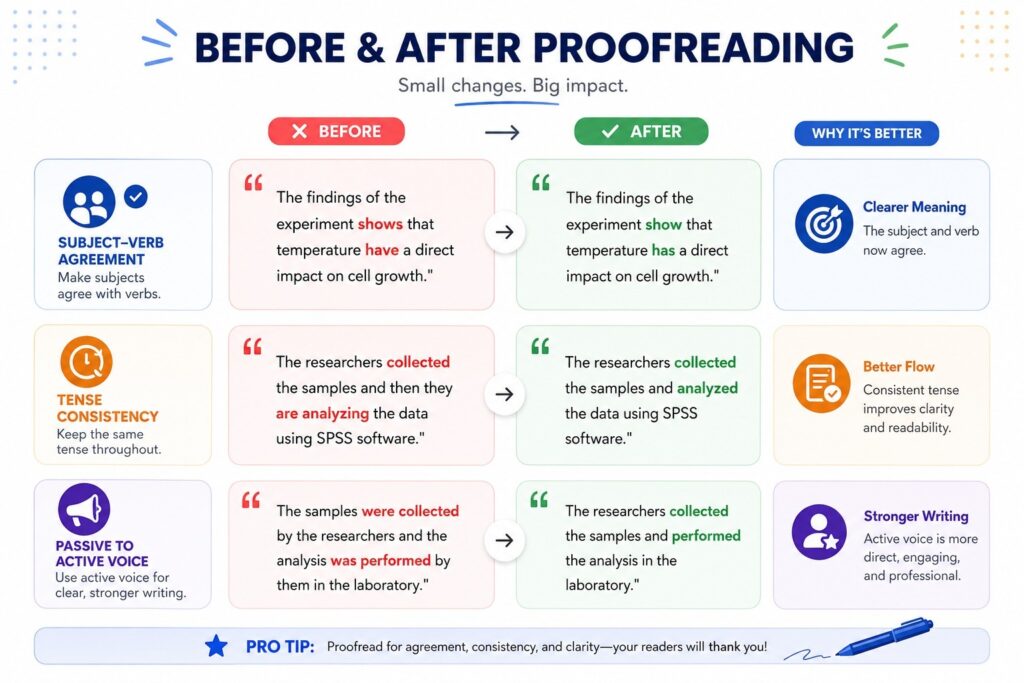
Eliminate Grammar and Spelling Errors
A manuscript with grammatical issues will not be reviewed carefully. Check subject-verb agreement across all sentences and maintain consistent tense for methods and results. Always review punctuation, especially comma spaces. Run spell-check and verify domain-specific terms
Key Tip: Use Grammar tools to catch surface errors — but always verify corrections manually. Tools often misread academic sentence structures or suggest edits that change meaning.
Scopus journals expect formal and objective writing. Remove colloquial expressions, contractions and informal transitions, words like may, might, using in manuscript will be reported as a claim.
Improve Sentence Structure Flow
Poor sentence flow reduces readability and reviewer engagement. Reviewers struggle to follow the argument and ensures the lower manuscript quality. Break sentences longer than 35 words into two or more shorter one, use transition words (however, therefore, moreover, consequently) to link ideas, ensure each paragraph has a clear topic sentence and logical progression.
Verify Figures, Tables, and Captions
Proofreading a research manuscript involves more than checking grammar and sentence structure. Figures, tables, and their captions are equally important because they communicate key scientific findings. Errors in numbering, labels, units, or captions can confuse reviewers and reduce the credibility of the manuscript.
Incorrect of relative pronouns
The words “that,” “which,” and “who” has different grammatical purposes. “That” introduces essential information; “which” introduces non-essential details (usually set off by commas); “who” refers to people. Correct usage improves both precision and professionalism.
Apply journal-specific formatting
Every Scopus-indexed journal provides detailed author guidelines that outline specific formatting requirements for manuscript submission. These instructions may include font style, citation format, heading structure, table layout, figure resolution, word limits, and reference style. Ignoring these requirements often signals to editors that the manuscript was not carefully prepared for the target journal, which can negatively affect the initial screening process.
Conclusion
Proofreading is a critical step in the publication journey, especially for Scopus Q1–Q2 journals. It ensures that language issues or avoidable errors do not undermine strong research. A well-proofread manuscript reflects professionalism, improves readability, and significantly increases the chances of acceptance in high-impact journals.