
Introduction:
Many of the manuscripts are getting rejected because of poor research. This happens because the formatting doesn’t match what the journal expects. The editor scans around 50 submissions a week, which will desk-reject a paper because of inconsistent headings, the wrong citation style, or low-resolution figures before they even read the abstract.
Scopus itself doesn’t set formatting rules; it’s a database that indexes journals, not a publisher. But every journal that is Scopus-indexed, which has its own author guidelines, small formatting details matter. A well-prepared manuscript is more likely to move smoothly into peer review, while formatting mistakes can lead to delays and requests for resubmission.
Here’s a practical checklist for getting your manuscript submission-ready.
Read the actual author guidelines, not a template you found online
This is the single biggest source of formatting errors. Every journal publishes an “Instructions for Authors” or “Guide for Authors” page, usually linked from the journal’s homepage or the submission portal. Don’t reuse a template from a similar-sounding journal or from a paper you read last year; guidelines change, and even journals from the same publisher (Elsevier, Springer, MDPI, Taylor & Francis) often differ in word limits, reference style, and section order.
Tips to remember: Open that page first. Keep it in a second tab while you format.
Match the required structure and section order
Most Scopus-indexed journals follow a standard structure that includes the Title, Abstract, Introduction, Methods, Results, Discussion, Conclusion, References, and any supplementary sections. However, section names, numbering styles, and the organisation of Results and Discussion may vary between journals. Always consult the journal’s author guidelines and recently published articles to ensure your manuscript follows the required format.
Use one consistent heading hierarchy throughout
This is where a lot of manuscripts fall apart. A paper drafted over months, sometimes by multiple co-authors, often ends up with headings in different fonts, different numbering styles, or inconsistent capitalisation; section 1 in bold sans-serif, section 2 in italic serif, section 3 with no number at all.
Set up heading styles (Heading 1, Heading 2, Heading 3) in your word processor before you start writing, and apply them consistently. Never manually bold and resize text to “look like” a heading; use the actual style, since most submission systems extract structure based on these styles, not visual appearance.
Get the citation and reference style
Scopus-indexed journals tend to use one of a few standard systems: APA, Vancouver/numbered, IEEE, or a publisher-specific variant. The in-text citation format and the reference list format must match exactly, including punctuation, italics, and whether the year comes in brackets.
A common mistake is mixing styles: numbered citations paired with an author-date reference list, or inconsistent use of “et al.” (sometimes italicised, sometimes not, sometimes missing the period). Run your reference list through the citation manager’s correct output style (Zotero, Mendeley, EndNote all support journal-specific styles) rather than formatting manually.
Format figures and tables to the journal’s technical specs
Figures and tables are common sources of formatting issues during manuscript submission. Authors should ensure that figures meet the journal’s requirements for resolution, file format, placement, and caption style. Tables should be editable rather than submitted as screenshots and must follow the journal’s formatting guidelines.
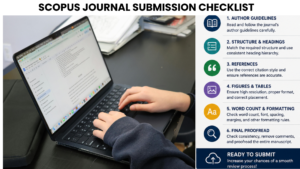
Check word count, margins, font, and spacing
Although these requirements may seem minor, submission systems often automatically flag manuscripts that do not comply with journal formatting guidelines. Authors should verify the required font style and size, line spacing, margin settings, and word count limits before submission. It is also important to confirm whether the journal’s word count includes or excludes the abstract, references, and supplementary materials.
Run a final consistency pass
Before submitting your manuscript, ensure that terminology, units, and numerical formatting are consistent throughout the document. Verify that all figures and tables are correctly numbered, cited in the text, and presented in the proper order. Finally, remove any tracked changes, comments, or placeholder text and confirm that the file name follows the journal’s submission requirements.
Before and after: a quick example
A few small formatting choices make a visible difference in how “submission-ready” a manuscript looks to an editor; mismatched heading styles, inconsistent citation formatting, and inconsistent numbering all signal a rushed submission, even when the underlying research is solid. Standardising heading levels, switching to the journal’s exact citation style, and applying consistent numbering throughout fixes this in minutes.
Tips to remember:
Build a one-page “formatting checklist” for the specific journal before you write a single word, not after. Pull every formatting requirement from the author guidelines has structure, citation style, figure specs, and word limits, into a single reference sheet.
Conclusion:
Format your manuscript as you write rather than leaving all formatting tasks until the end. Spending a few minutes following the journal’s requirements from the beginning can save significant time during the submission process and help present your work in a professional manner. While proper formatting alone cannot guarantee acceptance, poor formatting can create unnecessary barriers and may prevent a high-quality manuscript from advancing smoothly through editorial screening and peer review.