

In 2026, the academic publishing landscape is widespread. Thousands of journals are indexed in Scopus and Web of Science, spanning every possible discipline. More options should mean more opportunity, but without a clear process, they mean more confusion. The wrong choice costs you months of lost time, a desk rejection, and sometimes a paper that reaches the wrong audience, even when it does get accepted.
This guide walks you through a focused, step-by-step approach to getting the match right the first time.
A Strategic Approach to Journal Selection
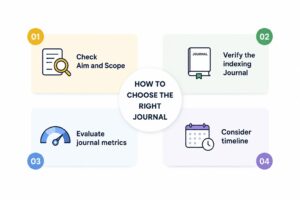
The single most common mistake researchers make is targeting a journal based on reputation before checking whether the journal is actually the right one for their work. A high Impact Factor or a strong Cite-Score is meaningless if the editorial team’s focus does not align with your paper’s topic, method, or audience.
Before you look at any metric, ask yourself: who genuinely needs to read this research? A paper on machine learning in clinical diagnostics might belong in a medical informatics journal, a healthcare AI publication, or an applied data science venue. Each has a different readership, a different editorial culture, and a different sense of what constitutes a meaningful contribution. A journal that regularly publishes studies like yours is usually the best place to submit your paper.
Read the aims and scope.
Every legitimate journal publishes an Aims and Scope statement. Most researchers glance at it. The ones who consistently publish well read it carefully, then cross-reference it against recent issues. A 2023 survey by the European Association of Science Editors found that scope mismatch accounts for roughly 40% of all desk rejections-papers turned away before they ever reach a peer reviewer. That is an enormous proportion of entirely avoidable failures.
40% of desk rejections were caused by Scope mismatch.
18% more citations received by open-access articles on average
6–12 weeks typical first-decision window at a reputable peer-reviewed journal
A practical test: find three papers published in your target journal in the past two years that are genuinely similar to yours in topic and methodology. If you cannot find three, the journal is probably not the right fit. This exercise takes twenty minutes and saves you weeks
Understand metrics —without being ruled by them
Impact Factor and Cite-Score are useful tools for comparing journals within a field, but they have real limitations. Impact Factor, published by Clarivate, measures average citations over a two-year window. Cite-Score, from Elsevier’s Scopus, uses a four-year window and tends to be more stable. Neither number tells you whether your paper will reach the scholars who can actually use it.
Crucially, these numbers are discipline-relative. A journal with an Impact Factor of 2.0 is highly regarded in the humanities and merely average in molecular biology. Always compare within your field, never across it. Use metrics to distinguish between journals that already fit your scope, not as the primary filter.
Verify indexing yourself — never trust a journal’s self-report
Scopus indexing signals to your institution, your peers, and funding bodies that your work has cleared an internationally recognised quality threshold. But the keyword is “verify.” Predatory journals routinely misrepresent their indexing status on their own websites. Always confirm a journal’s current listing through the official Scopus Source List at scopus.com. Indexing status changes — journals are added and removed — so a quick, direct check before submission takes seconds and protects you from a costly mistake.
Factor in timelines and open access
Time is a real constraint for most researchers. Early-career academics building a publication record, doctoral candidates with graduation deadlines, and researchers working within grant-reporting cycles all need to factor in a journal’s review turnaround time. A reputable peer-reviewed journal typically issues a first decision within six to twelve weeks. Any journal advertising decisions in under two weeks should prompt scrutiny — genuine peer review takes time, and speed claims often mean something has been skipped.
On open access: articles published without a paywall receive around 18% more citations on average, according to multiple analyses. Many high-quality Scopus-indexed journals now offer gold open access with an Article Processing Charge. Before committing to any APC, independently verify the journal’s legitimacy. If a journal solicited you by unsolicited email, promising fast publication and guaranteed indexing for a fee, walk away. Legitimate journals do not work that way.
Key tip
Before choosing a journal, check whether it has recently published papers similar to yours. If you cannot find at least three similar articles from the last two years, that journal may not be a good fit for your research.
Example in practice
A researcher submits a mixed-methods study on digital health adoption among rural populations. She targets a high-ranking general health journal because of its CiteScore. It is desk-rejected within five days — the journal focuses on clinical trials and biomedical outcomes. She then applies the three-paper test to three other journals, finds a strong match in a health informatics journal that has recently published two qualitative studies and one survey-based study on similar populations, and submits there. First decision arrives in seven weeks: revise and resubmit.
Begin journal selection before the manuscript is finished
Experienced researchers do not treat journal selection as a final step. They begin identifying candidate journals during the writing process, which allows them to tailor the paper’s framing, structure, and citation choices to align with the expected audience. If your target journal consistently publishes papers that foreground policy implications, you know to develop that section more fully. If it favours a particular methodological style, you know how to frame your approach.