

Introduction
Publishing in a Scopus-indexed journal is a significant milestone for researchers. It enhances academic credibility, increases research visibility, and contributes to career advancement. However, many manuscripts never reach the peer-review stage because they are desk rejected by the journal editor.
A desk rejection occurs when the editor decides that a manuscript is unsuitable for publication before sending it to external reviewers. While this may seem discouraging, the good news is that most desk rejections are preventable with careful preparation and attention to journal requirements.
This guide explains the common reasons for desk rejection and provides practical strategies to help researchers improve their chances of progressing to peer review.
What Is a Desk Rejection?
A desk rejection is an editorial decision to reject a manuscript without external peer review. Editors make this decision after evaluating whether the manuscript aligns with the journal’s aims, quality standards, ethical requirements, and submission guidelines.
Unlike peer-review rejection, a desk rejection usually occurs within a few days to a few weeks after submission.
Why Do Editors Reject Manuscripts Without Peer Review?
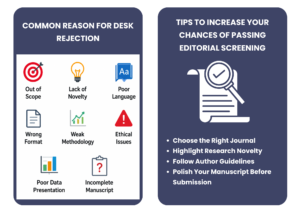
Editors receive hundreds or even thousands of submissions each year. Since reviewer time is limited, editors first screen manuscripts to determine whether they meet the journal’s basic publication standards. During editorial screening, editors evaluate whether the manuscript aligns with the journal’s scope, demonstrates novelty and scientific quality, maintains clear writing, complies with ethical standards, follows formatting guidelines, and includes all required submission components. Failure to meet one or more of these criteria may result in an immediate desk rejection.
Common Reasons for Desk Rejection
The Manuscript Is Outside the Journal’s Scope
One of the most frequent reasons for desk rejection is submitting to the wrong journal. Even high-quality research may be rejected if it does not match the journal’s focus, subject area, or target audience.
Tips to avoid this:
To ensure your manuscript is a good fit, carefully read the journal’s aims and scope, review recently published articles, and confirm that your research aligns with the journal’s focus and target audience. Selecting the right journal significantly improves your chances of passing editorial screening.
Lack of Novelty
Editors look for research that contributes new knowledge. Manuscripts that merely repeat existing studies without meaningful advancement are less likely to proceed to peer review.
Improve novelty by:
To demonstrate novelty, clearly identify the research gap, explain why the study is important, and emphasise your unique contribution. Highlight these aspects effectively in the abstract and introduction to show how your research advances existing knowledge.
Poor Manuscript Structure
A poorly organised manuscript creates a negative first impression. Editors expect a logical structure with clear sections. A standard research article should include: Title, Abstract, Keywords, Introduction, Literature Review (if required), Methodology, Results, Discussion, Conclusion and References
Weak English and Language Errors
Grammar mistakes, awkward sentences, and unclear writing reduce readability. Editors may reject manuscripts that require extensive language corrections. Before submitting your manuscript, proofread multiple times.
Failure to Follow Author Guidelines
Every journal has detailed submission requirements. Ignoring these instructions signals carelessness. Common issues include: Incorrect reference style, Wrong manuscript template, Missing declarations, exceeding word limits, Incorrect figure formatting. Always review the journal’s author guidelines before submission.
Poor Abstract
The abstract is often the first section editors read. A weak abstract may immediately reduce confidence in the manuscript.
Weak Methodology
Editors assess whether the research methods are scientifically sound.
Common methodological problems include using a small or unjustified sample size, providing insufficient methodological details, applying inappropriate statistical analyses, and failing to include validation procedures. Authors should provide enough information to ensure that readers can clearly understand and reproduce the study.
Inadequate Literature Review
A literature review should demonstrate knowledge of current research. Editors expect authors to cite recent and relevant publications while explaining how the new study addresses existing gaps. Avoid relying heavily on outdated references.
Ethical Concerns
Ethical compliance is essential. Editors may reject manuscripts involving: Always maintain transparency throughout the research process.
Poor Data Presentation
Tables and figures should improve understanding rather than create confusion. Avoid using low-resolution images, inconsistent formatting, duplicate information, or unclear labels in tables and figures. Present your data clearly, accurately, and according to the journal’s guidelines. Well-organised visuals improve readability and create a positive impression on editors.
Conclusion
Desk rejection is a common part of academic publishing, but it is often avoidable. By selecting the right journal, demonstrating the novelty of your research, following submission guidelines, presenting a well-structured manuscript, and maintaining high ethical standards, researchers can significantly improve their chances of progressing to peer review.
Careful preparation before submission not only reduces the likelihood of desk rejection but also strengthens the overall quality and impact of your research. Investing time in refining your manuscript today can lead to a smoother publication journey and greater success in Scopus-indexed journals.