

Submitting a manuscript to a Scopus-indexed journal is a significant milestone in any researcher’s academic journey. After investing substantial time in conducting research, analysing findings, and preparing a manuscript, many authors are eager to move quickly to the submission stage. However, rushing this final step can lead to avoidable delays, desk rejections, and extensive reviewer comments that could have been prevented with proper preparation.
The successful publication starts before a manuscript reaches an editor’s desk. Journals evaluate not only the quality of the research but also how effectively that research is presented. A carefully prepared submission demonstrates professionalism, attention to detail, and respect for the journal’s editorial standards. Before clicking the submit button, researchers should ensure that every aspect of the manuscript is publication-ready.
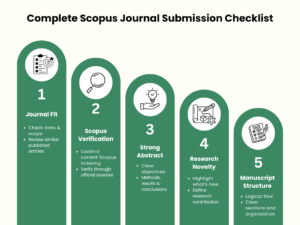
Confirm That the Journal Is the Right Fit
One of the most common reasons for immediate rejection is a mismatch between the manuscript and the journal’s scope. Authors should carefully review the journal’s aims and scope and examine recently published articles. If the journal regularly publishes studies similar to yours in terms of topic, methodology, and audience, it is likely a suitable choice. A strong alignment between the manuscript and the journal’s focus significantly improves the chances of progressing to peer review.
Verify the Journal’s Scopus Indexing Status
Many researchers assume that a journal remains indexed indefinitely. However, indexing status can change over time. Before submission, it is essential to verify that the journal is currently listed in Scopus. Relying solely on claims displayed on a journal’s website can be risky. A quick verification through official sources can prevent costly mistakes and ensure that the publication meets institutional and funding requirements.
Evaluate the Strength of the Abstract
The abstract is often the first section read by editors, reviewers, and future readers. It should clearly communicate the purpose of the study, methodology, key findings, and major conclusions. A weak or vague abstract can create a negative first impression regardless of the quality of the research itself. Authors should review the abstract carefully to ensure that it accurately represents the manuscript and highlights its contribution.
Ensure the Research Contribution Is Clearly Defined
Editors frequently ask a simple question when evaluating a manuscript: What is new about this research? If the novelty and significance of the study are not immediately apparent, the manuscript may struggle during review. Authors should clearly articulate how their work differs from existing literature and explain why the findings matter to the broader academic community.
Review the Structure and Flow of the Manuscript
Well-structured studies can be difficult to follow if the manuscript lacks logical organisation. Each section should connect naturally to the next, guiding readers through the research process. The introduction should establish the problem, the methodology should be transparent, the results should be presented clearly, and the discussion should interpret the findings within the context of existing research.
Check Language and Readability
Language quality plays a critical role in publication success. Grammatical errors, awkward sentence structures, and inconsistent terminology can distract reviewers and obscure important findings. Professional proofreading and manuscript editing can improve clarity, readability, and overall presentation, helping the research communicate its value more effectively.
Verify References and Citations
Reference lists often receive less attention than they deserve. Incomplete citations, formatting inconsistencies, and outdated references can create a poor impression. Authors should ensure that all references are accurate, properly formatted according to journal guidelines, and relevant to the study. Citations should also demonstrate awareness of recent developments within the field.
Review Ethical and Compliance Requirements
Most Scopus-indexed journals have strict ethical standards. Before submission, authors should verify that ethical approvals, informed consent statements, conflict of interest declarations, funding acknowledgements, and data availability statements have been included where required. Missing documentation can delay review or result in administrative rejection.
Prepare a Strong Cover Letter
A cover letter provides an opportunity to introduce the manuscript directly to the editor. Rather than simply summarising the paper, authors should briefly explain the study’s significance, its relevance to the journal’s audience, and why it deserves consideration. A thoughtful cover letter can help position the manuscript effectively from the outset.
Conduct a Final Submission Review
Before submission, authors should review the entire package as an editor would. This includes checking manuscript files, figures, tables, supplementary materials, author information, keywords, and formatting requirements. Small mistakes at this stage can create unnecessary complications later in the review process.
Key Tip
Before submitting to any Scopus journal, apply the “three-paper test.” Identify three articles published in the journal within the last two years that closely resemble your study in topic, methodology, and scope. If you cannot find three strong matches, consider whether another journal may be a better fit. This simple exercise often predicts publication success more accurately than journal metrics alone.
Example in Practice
A doctoral researcher completes a manuscript examining the adoption of artificial intelligence tools in higher education. Excited to publish quickly, the researcher submits the paper to a high-ranking Scopus journal based primarily on its Cite-Score. Within a week, the manuscript receives a desk rejection because the journal primarily publishes technical AI development studies rather than educational applications. After reassessing the manuscript using the three-paper test, the researcher identifies a Scopus-indexed educational technology journal that has recently published several studies on AI adoption in learning environments. The revised submission progresses to peer review and receives constructive reviewer feedback, leading to eventual publication.
Publication Success Begins Before Submission
Submitting a manuscript to a Scopus-indexed journal should never be viewed as a simple administrative step. It is the culmination of careful planning, strategic journal selection, thorough manuscript preparation, and attention to detail. Researchers who invest time in reviewing every aspect of their submission are better positioned to navigate peer review successfully and achieve meaningful publication outcomes.