
Introduction
In 2026, every researcher uses AI for writing. Tools like ChatGPT and Grammarly have become reference managers. Nowadays, journals are tightening their language around AI-assisted writing, and peer reviewers are increasingly trained to spot: generic phrasing, repetitive sentence structures, and a strange flatness in argumentation. This will put researchers in a difficult spot.
Writing a paper is not the same as editing one
Using AI to write an entire paper is different from using an AI to edit a manuscript. AI can improve grammar and readability, but it cannot replace a researcher’s critical thinking, data interpretation, or scientific expertise. Scopus Q1 and Q2 journals expect original contributions supported by sound methodology and evidence. Therefore, AI is most effective as a writing assistant rather than the primary author.
What AI writing is actually good for
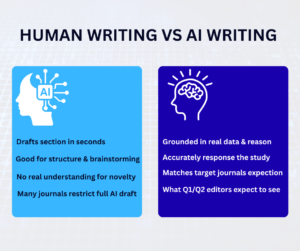
Used correctly, AI is a strong brainstorming and structuring partner. It can suggest a logical outline for a literature review, propose section headings that match conventions in your field, or generate a rough first draft of a paragraph you can then rewrite using your own findings. This kind of scaffolding genuinely saves time without putting your manuscript’s credibility at risk.
The risk appears when researchers let AI write substantive content directly into the manuscript, especially in the methodology, results, and discussion sections. AI has no access to your actual data, your specific instruments, or your real experimental conditions. When asked to fill in these sections, it defaults to fluent, plausible-sounding language that describes a generic version of your study rather than the one you actually ran.
Why human-written sections hold up better under review
A human author writing their own methodology section naturally includes the specific details that make a study verifiable: sample sizes, instruments used, software versions, and statistical tests applied. These details aren’t decorative, but they exactly mention what a Q1 methods reviewer checks first, because reproducibility is a core criterion for high-impact journals.
Human-written discussion sections also tend to engage more directly with the actual implications of the findings, including limitations the author is aware of from having run the study themselves. AI-generated discussion sections, by contrast, often produce generic statements about “future research directions” that could apply to almost any paper in the field were a pattern experienced reviewers recognise instantly.
There’s also a growing policy dimension. Major Scopus-indexed publishers, including Elsevier, Springer Nature, and IEEE, now explicitly restrict the use of AI to generate substantive manuscript content, requiring disclosure where AI tools are used at all. If a researcher uses AI to write parts of a paper and does not tell the journal about it, or submits the paper to a journal that does not allow AI-generated content, the paper may be rejected even if the writing is excellent.
A real example: drafting a methodology sentence
Consider a researcher who prompted ChatGPT to write a methodology section for a healthcare survey study. The AI produced: “In this study, a mixed-methods approach was employed to comprehensively analyse the data, ensuring a robust and thorough investigation of the research questions.” This sentence is fluent and grammatically perfect and almost empty. It states no sample size, no instrument, no actual procedure.
The same researcher, writing from their own study and refined with human editorial input, produced: “We surveyed 412 participants across three urban hospitals using a validated 18-item questionnaire, then applied multivariate regression in R (v4.3) to test the proposed model against three competing hypotheses.” This version is specific, reproducible, and verifiable reviewer can evaluate the actual rigour of the study from this sentence alone, which is precisely what a Q1 methods section needs to do.
Three practical tips before you write for a Scopus journal
- Use AI for outlines, never for substance.
Let AI suggest section structure, headings, or a rough skeleton for your literature review. Write the methodology, results, and discussion yourself, since these sections need real, verifiable details only you have access to.
- Check your target journal’s AI policy before you start.
Publishers like Elsevier and Springer Nature publish explicit guidance on permitted AI use. Reading this before drafting avoids a desk rejection over a policy violation that has nothing to do with your research quality.
- Scan AI-assisted drafts for vague, generic phrasing.
Phrases like “comprehensive analysis” or “robust investigation” without supporting specifics are a signature of AI-generated text. Replace them with concrete numbers, tools, and procedures before submission.
Conclusion:
For Scopus journals, AI writing is a useful scaffolding tool but a poor substitute for the substance only a human author can provide. Q1 and Q2 reviewers are specifically trained to spot generic, ungrounded language, and increasingly, publishers’ own policies restrict how much AI-generated content is even allowed. The strongest manuscripts use AI to plan and structure, then rely on the researcher’s own voice and verified detail to do the actual writing with a human editor making sure that voice meets the journal’s standard before submission.