
Introduction:
Researchers spent months and sometimes years to design their study and writing up findings. And they submit to the prestigious Scopus journal, the editor’s response arrives within days: “Desk rejected due to language and presentation concerns.” No peer review, No feedback on your research. Just a polished dismissal. This happens to thousands of researchers every year, and the tragedy is that it is almost entirely preventable. “Professional editing is not merely an optional service ; it is one of the most impactful steps in the academic publishing journey.”
What editors actually see when they read your manuscript
Q1 journal editors receive hundreds of submissions every month. In that volume, they develop a rapid pattern-recognition ability and they can detect a poorly edited manuscript within the first two paragraphs. It is not just about grammar. Editors are reading for clarity of argument, logical flow, consistency of terminology, and precision of expression. When any of these are weak, it creates a single powerful impression: that the research itself may be equally careless.
Professional editing addresses all of these dimensions simultaneously. A trained academic editor does not simply fix commas and verb tenses; they restructure sentences for impact, align your abstract with your findings, smooth the logic between sections, and ensure your manuscript reads as a coherent scholarly argument from start to finish.
Grammar and clarity : The first gate every manuscript must pass
For non-native English speakers; who make up the majority of Scopus submitters globally will face language quality is the most common barrier to Q1 acceptance. But this is not simply about speaking English fluently. Academic English has its own register, conventions, and precision requirements that are entirely different from everyday communication. Passive voice, hedging language, nominalization, and citation integration are all discipline-specific skills that take years to master.
A professional academic editor who specialises in your field will not just fix errors, they will elevate your prose to the level of native academic writing. This is the difference between a manuscript that reads as competent and one that reads as authoritative.
Structure and flow
Many researchers write excellent individual sections but struggle to connect them into a coherent, flowing argument. The introduction doesn’t clearly set up the methodology. The results section contains interpretation that belongs in the discussion. The conclusion repeats the abstract verbatim. These are structural problems and they are invisible to the author who wrote them, because the author already knows what they mean. A professional editor reads your manuscript as a complete stranger, exactly as a peer reviewer will.
A vertical flowchart showing how each section of a manuscript feeds into the next: Introduction → identifies gap → Methods → designed to fill gap → Results → answers the gap → Discussion → contextualises the answer → Conclusion → states the contribution. Use connecting arrows with brief annotation labels. Dark navy background, gold arrows, teal section labels.
Professional editors flag these disconnects and suggest reorganisation. They ensure your research gap in the introduction is directly answered by your results section, and that your discussion connects back to the specific literature you cited at the start. This narrative coherence is what separates a publication-ready manuscript from a rejected one — and it is nearly impossible to see in your own writing.
Tips to Remember:
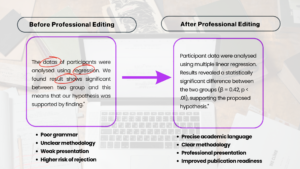
Editor note: “Added theoretical anchoring, comparative framing, and explicit connection to your introduction’s cited framework. This transforms a result-summary into genuine academic discussion.”
Formatting compliance: what editors check before they read a word
Every Q1 journal publishes detailed author guidelines covering reference style, abstract word count, section headings, table formatting, figure resolution, and manuscript length. Failing to comply with even one of these requirements signals to the editor that you have not read the guidelines which is a strong indicator that the manuscript may not be a good fit for their journal.
✓ Reference list formatted exactly in the journal’s required style (APA, Vancouver, AMA, or house style)
✓ Abstract structured per journal template – word count, section labels, keyword format
✓ Tables formatted in APA 3-line style with no vertical borders and a Note. row below
✓ Figures exported at 300 DPI minimum as TIFF or high-quality PNG
✓ Line spacing, font size, and margin settings matching the journal’s template
✓ Ethical approval reference number included in the Methods section
✓ Conflict of interest and funding statements present and correctly formatted
Plagiarism and originality
How editors catch hidden similarity issues before submission
Professional editing services typically include a plagiarism screening using iThenticate or Turnitin as part of their package. This is not just about detecting obvious copying , it also finds self-plagiarism from your own prior conference papers, overly close paraphrasing of source material, and methodology text that has been reused too closely. Q1 journals run every submission through CrossCheck, and a similarity score above 15–20% (excluding references) is frequently grounds for desk rejection.
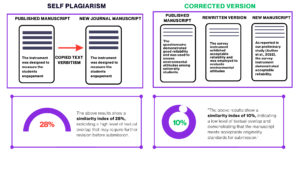
✗ Self-plagiarism (detected)
Copying 3 paragraphs verbatim from your own 2022 conference paper into the new manuscript without quotation or citation; even though you wrote both.
✓ Correct approach
Rewriting the material entirely in fresh language and citing: “As we reported in our preliminary study (Author et al., 2022), the instrument demonstrated acceptable reliability…”
Conclusion:
Professional editing is not about hiding the weaknesses of your research, it is about ensuring your research’s genuine strengths are communicated with the clarity and precision that Q1 peer reviewers and editors demand. A single round of professional editing before submission can be the difference between a desk rejection and a peer-reviewed acceptance.