
Publishing your manuscript in a Scopus-indexed journal is an important milestone for researchers worldwide. Thousands of manuscripts rejected every year – not because of poor research, but because they make avoidable mistakes. Poor formatting makes the manuscript weak, these errors will lead to rejection and paper will not meet international publication standards.
This blog will break down the 10 most common mistakes, and tells you how to fix it.
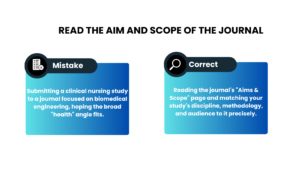
1 Ignoring the journal’s scope and aim
Submitting a manuscript to a journal without reading its aim and scope is the fastest way of desk rejection. Editors immediately recognise when a paper has been sent blindly to multiple journals. Always verify that your research topic aligns precisely with what the journal publishes.
2 Poor title and abstract structure
The abstract is the first thing a reviewer reads and often the only thing before they decide whether to continue. A vague, overly long, or unstructured abstract is not accepted. Scopus-indexed journals expect a structured abstract that clearly communicates purpose, method, results, and conclusion.
Follow the IMRaD structure: Background → Objective → Methods → Results → Conclusion. Keep it under 250 words and avoid citations inside the abstract. Use keyword-rich language to improve discoverability in Scopus indexing.
3 Weak or outdated literature review
A literature review should include that you are aware of current research in your field. Citing only old studies (5+ years ago) or missing key Scopus-indexed papers in your domain signals to reviewers that the study may not be grounded in contemporary knowledge.
Citing a mix of foundational works and recent (last 3–5 years) Scopus-indexed articles, clearly showing the research gap your study addresses.
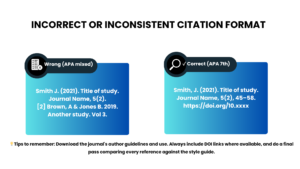
4 Incorrect or inconsistent citation format
Different journals follow different citation styles. APA, AMA, Vancouver, Harvard, or their own style. Submitting a paper with mixed citation formats, missing DOIs, or incorrectly formatted references is a common and easily avoidable error that makes editors doubt your attention to detail.
Download the journal’s author guidelines and use a reference manager like Zotero or Mendeley set to the correct citation style. Always include DOI links where available.
5 Insufficient sample size or methodology justification
Reviewers critically assess whether your research methodology is rigorous. A study with an unjustified sample size, vague data collection process, or missing ethical approval raises serious validity concerns particularly in medical, social science, and education research.
6 Plagiarism and self-plagiarism
Plagiarism means recycling large portions of your own previously published work (self-plagiarism) is a serious violation that will result in immediate rejection and can damage your academic reputation. Scopus-indexed journals use advanced detection tools like iThenticate or CrossCheck.
Run your manuscript through Turnitin or iThenticate before submission. Aim for a similarity score below 15% (excluding references). Rewrite any recycled content in fresh language and cite yourself appropriately when referring to prior work.
7 Poor English language quality
Grammatical errors, awkward phrasing, and unclear sentences significantly reduce a paper’s chances of acceptance, even if the research is excellent. Non-native English speakers are particularly vulnerable to this issue, but even native speakers overlook language quality under time pressure.
Use Grammarly Premium or engage a professional academic English editing service (e.g., Enago, Editage, or American Journal Experts). Many Scopus journals explicitly request a language certificate from these services before acceptance.
8 Failing to highlight the research gap clearly
A common structural weakness is failing to explicitly state what is missing in existing literature and how your study fills that gap. Without a clearly articulated research gap, reviewers question the novelty and contribution of your work is the two most critical acceptaced criteria.
9 Tables and figures not following the journal format
Incorrectly formatted tables with unnecessary gridlines, missing titles, unlabelled axes, or low-resolution images are a common formatting error. Most Scopus journals have strict requirements for figures (minimum 300 DPI) and tables (no vertical lines, APA-style formatting).
10 Inadequate discussion and conclusion section
Many authors summarise their results in the discussion instead of interpreting them. A strong discussion goes beyond “the results showed “what is the research says ”it explains why it happened, compares it to prior literature, and discusses theoretical and practical implications. Similarly, a conclusion that merely repeats the abstract adds no value.
Conclusion: Scopus journal rejection is rarely about the quality of your research idea, it always about presentation, rigour, and adherence to standards. By addressing these 10 mistakes before submission, you dramatically improve your manuscript’s credibility in the view of editors and peer reviewers. Publishing in a Scopus-indexed journal opens doors to greater academic visibility and citation impact. The effort you invest in getting these fundamentals right is always worth it.