

Introduction
Publishing in a Scopus-indexed journal can seem difficult, especially for first-time authors. Many researchers spend hours for writing manuscripts, only to face rejection during the submission process. This can make academic publishing feel confusing and unpredictable.
Most accepted papers follow a set of practical steps that improve their chances of passing editorial screening and peer review. While no guide can guarantee acceptance, understanding these steps can help researchers avoid common mistakes and make the publication process much smoother.
The following five tips can help researchers improve their chances of publishing successfully in a Scopus-indexed journal
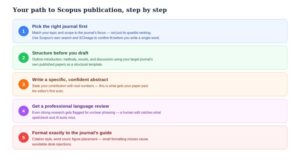
Choose the Right Journal
One of the most important decisions in the publication process is selecting the right journal. Many authors focus only on journal rankings or impact factors and submit their work to the most prestigious journal they can find. Unfortunately, this approach often leads to rejection. Editors frequently reject papers because they do not fit the journal’s scope. Even a high-quality study may be unsuitable if it does not match the interests of the journal’s readers.
Before submitting your manuscript, spend time identifying journals that regularly publish research similar to yours. Read several recently published articles and examine their topics, methods, and objectives. Ask yourself whether your study would fit naturally among those papers.
For example, imagine a researcher develops a fraud-detection model designed specifically for healthcare billing systems. If the paper is submitted to a broad computer science journal, reviewers may view the healthcare focus as too specialized. The manuscript could be rejected before its scientific value is fully evaluated.
However, if the same paper is submitted to a healthcare informatics journal, the topic aligns directly with the journal’s audience and goals. The research itself has not changed, but the chances of acceptance may increase significantly because the journal is a better fit.
Choosing the right journal can often be the difference between rejection and acceptance.
Learn from Published Articles
Many researchers begin writing without examining how papers are typically structured in their target journal. This can be a mistake because each journal has its own expectations regarding organization and presentation. Before preparing your manuscript, read three to five recent articles published in your chosen journal. Pay attention to how authors structure their introductions, literature reviews, methods, results, and discussions.
You may notice that some journals prefer shorter introductions, while others expect more detailed background information. Some journals emphasize practical implications, while others focus heavily on theoretical contributions.
Studying published articles provides a useful template for your own manuscript. It helps you understand what editors and reviewers are accustomed to seeing and allows you to present your research in a familiar and professional format.
Following the journal’s style does not mean copying other papers. Instead, it means learning how successful authors communicate their findings within that publication
Write a Strong and Clear Abstract
The abstract is often the first part of the manuscript that editors and reviewers read. In some cases, it strongly influences whether a paper proceeds to peer review. A good abstract should clearly explain the purpose of the study, the methods used, the main findings, and the significance of the results. Readers should be able to understand the value of the research within a few minutes.
Avoid vague statements such as “the results were promising” or “the method performed well.” Instead, provide specific information whenever possible. A well-written abstract creates a positive first impression and encourages editors and reviewers to continue reading the manuscript
Pay Attention to Language Quality
Even excellent research can be negatively affected by poor writing. Reviewers may struggle to understand the study if the language is unclear, overly complex, or full of grammatical errors.
Today, many researchers use AI tools and grammar-checking software to improve their writing. These tools can be helpful for identifying spelling mistakes and basic grammar issues. However, they cannot always detect unclear explanations, awkward sentence structures, or inappropriate academic tone.
For this reason, it is important to carefully review your manuscript before submission. If possible, ask a colleague, supervisor, or professional editor to read the paper. A fresh reader can often identify sections that are confusing or difficult to understand.
Clear and professional language helps reviewers focus on the quality of the research rather than the quality of the writing.
Remember that reviewers evaluate not only what you discovered but also how effectively you communicate your findings.
Follow the Author Guidelines Carefully
Many researchers underestimate the importance of journal formatting requirements. However, journals often conduct an initial technical screening before sending papers to editors or reviewers.
During this stage, manuscripts may be checked for word limits, citation styles, figure quality, file formats, and other submission requirements. Failure to follow these instructions can delay the review process or even result in immediate rejection.
Tips to remember: Before submitting your manuscript, carefully read the journal’s author guidelines. Make sure that your references follow the required style, figures meet resolution standards, tables are properly formatted, and all required documents have been uploaded.
Conclusion
Publishing in a Scopus-indexed journal does not have to be a confusing process. While acceptance can never be guaranteed, researchers can significantly improve their chances by following a few practical steps.
Selecting a journal that matches your research, studying recently published articles, writing a clear abstract, improving language quality, and carefully following author guidelines can help eliminate many of the common reasons manuscripts are rejected.
When these basics are handled properly, editors and reviewers can focus on what truly matters—the quality and contribution of your research. Instead of relying on guesswork, researchers can approach the publication process with greater confidence, preparation, and professionalism.