

Introduction
Researchers receive the email as : “We have now received reports from our advisors on your manuscript. The reviewers have raised significant concerns…”. But here’s the truth most researchers don’t know: receiving a major revision decision is not rejection. In most Scopus Q1 journals, it is an invitation to publish your manuscript strategically. The way you respond to reviewer comments is often more decisive than the research itself.
This blog will guide you the exact framework to turn even complicated reviewer feedback into an acceptance letter.
Understanding reviewer types : Identify the Type of Reviewer Before Responding
Not all reviewer comments are created equal. Learning to categorise the comments you receive will prioritise your effort and frame your responses appropriately. Most reviewers fall into one of three types, and your response strategy should differ for each.
| Reviewer type | What their comments look like | How to respond |
| The constructive expert | Detailed, specific, clearly knows your field; points to specific gaps, missing citations, or methodological issues | Respond as a collaborator. Thank them by name (Reviewer 1), address every point precisely, show exactly what you changed and why. |
| The vague critic | “The literature review is weak” or “The discussion lacks depth”- no specific guidance on what to add | Ask yourself what a thorough expert in this area would want. Add what you think is missing and explain your interpretation of the concern. |
| The dissenter | Fundamentally disagrees with your theoretical framework or methodology may seem ideologically opposed | Never argue. Acknowledge the perspective, explain your rationale clearly, and if you cannot change your approach, justify it with citations. |
How to respectfully push back without damaging your chances
Sometimes a reviewer is simply wrong, or their suggestion would fundamentally compromise your research design. In these cases, authors often make one of two errors: they either comply with a bad suggestion to avoid conflict, or they argue back defensively. Both approaches damage your submission. The correct strategy is the academic disagreement protocol: acknowledge, explain, evidence, and offer an alternative.
Example Format:
When you cannot comply with a reviewer request, always end your response with: “We have acknowledged this limitation/alternative perspective in the [Discussion / Limitations] section (page X, lines Y–Z).” This shows the editor you have engaged seriously with the concern ; even without making the change the reviewer wanted.
Formatting your rebuttal letter like a professional
The visual presentation of your rebuttal letter matters more than most authors realise. A well-formatted response letter signals attention to detail and respect for the reviewers’ time. It also makes the editor’s job significantly easier ; they can quickly verify that every concern has been addressed. Use the following checklist to format your rebuttal before submitting.
✓ Open with a brief cover paragraph thanking the editor and all reviewers for their time and constructive feedback
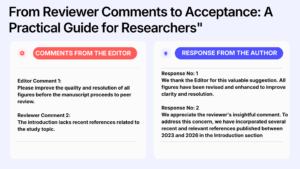
✓ Use clear headings: “Response to Reviewer 1,” “Response to Reviewer 2,” “Response to Editor”
✓ Quote each reviewer comment in italics or a shaded box so it is visually distinct from your response
✓ Every response must reference an exact page and line number in the revised manuscript
✓ End with a summary table listing: Comment Number, Action Taken, Page Reference
✓ In the revised manuscript, use tracked changes or highlight all new/revised text in a different colour
Example : Cover paragraph of a rebuttal letter
Dear Professor [Editor Name], We sincerely thank you and the reviewers for the careful evaluation of our manuscript (MS-2025-XXXXX). The reviewers’ comments have been invaluable in strengthening our work. We have addressed all concerns point-by-point below. All revisions are highlighted in blue in the revised manuscript for ease of review. We hope the revised manuscript now meets the standards of [Journal Name] and look forward to your decision. Sincerely, [Corresponding Author Name].
What happens next, and how to handle a second round
After resubmission, most Q1 journals send your revised manuscript back to at least one of the original reviewers. If your first response was thorough and respectful, the second review is almost always shorter and more positive. However, if additional concerns are raised in Round 2, respond to them carefully and professionally. New concerns in a second review are actually a sign that the reviewer is reading your work more carefully and engaging with it as a serious piece of research.
Conclusion:
Peer review is not a verdict; it is a conversation. The reviewer’s job is to improve your research, not to reject it. The editor’s job is to publish the best version of your work, not to find reasons to turn it away. When you respond to reviewer comments carefully (rigour), politely (respect), and accurately (precision), you are doing more than just completing a required step in the publication process. You are showing the professionalism, academic maturity, and research quality that top Q1 journals value in their authors.
Every comment is an opportunity. Treat it that way, and your resubmission becomes significantly stronger than your original submission. That is how Major Revisions become acceptance letters.