

Every year, thousands of researchers unknowingly publish in predatory journals which decreases academic credibility in return. The damage isn’t just wasted money; it can quietly undermine a researcher’s credibility for years. This article breaks down exactly what separates a predatory journal from a legitimate Scopus-indexed one, with a real example you can apply today.
What makes a journal “predatory” in the first place
A predatory journal is a publication that mimics the appearance of a legitimate academic outlet official-sounding name, a professional-looking website, and an “impact factor” listed on the homepage, while skipping the actual substance of scholarly publishing. There is little or no real peer review, and manuscripts are typically accepted with only a fee in exchange, regardless of quality.
These journals have grown more sophisticated in recent years. Many now use names that closely resemble well-known journals, display official-looking ISSN numbers, and even claim affiliations with real academic associations they have no actual connection to. This makes a quick glance at a journal’s homepage an unreliable way to judge legitimacy were deeper check is required.
Why Scopus indexing is a meaningful signal of legitimacy
Scopus, maintained by Elsevier, indexes only journals that meet strict standards for editorial quality, peer review, publication consistency, and citation performance. These journals are regularly re-evaluated and can be removed if their quality declines. This ongoing assessment is why Scopus indexing and a journal’s quartile ranking (Q1–Q4) are widely trusted by universities, funding agencies, and employers. Predatory journals may imitate legitimate journals, but they cannot obtain genuine Scopus indexing, which is why researchers should always verify a journal directly in Scopus rather than relying on claims made on the journal’s website.
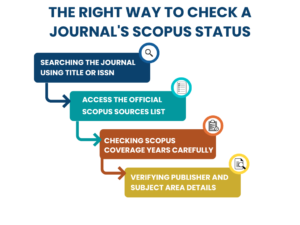
Before submitting to any unfamiliar journal, a short verification process can save months of wasted effort. Start by searching the journal’s exact name directly on Scopus’s own website — not through a link the journal provides, since predatory sites sometimes link to unrelated, legitimate Scopus pages to imply a false association.
From there, check the editorial board for real, verifiable academic profiles — search a few names individually and confirm they list affiliation with the journal itself. Finally, look at how the journal was contacted: an unsolicited mass email promising fast, guaranteed acceptance is one of the most consistent predatory journal patterns across disciplines.
A real example: checking an actual invitation email
Consider an email a researcher might receive out of the blue: an invitation from “Global Journal of Research Publication,” promising publication within three to five days, a 100% acceptance guarantee, and a $299 processing fee payable only after acceptance. The tone is flattering, the offer is fast, and the financial ask seems reasonable on its face.
A five-minute check tells a different story. The journal doesn’t appear in a direct Scopus or Web of Science search. Its “editorial board” page lists names with no verifiable academic profile when searched individually. And a quick domain lookup shows the website was registered less than a year ago, with no physical address listed anywhere. Each of these checks takes under two minutes, and together they’re enough to confirm this is a journal to avoid entirely.
Three tips to protect yourself before submitting
- Always verify on Scopus directly, never through a link the journal provides.
Go to scopus.com yourself and search the journal’s exact title. Predatory sites sometimes embed links to real, unrelated Scopus pages to imply a false association : on’t trust a link, verify the search result yourself.
- Be suspicious of speed and certainty.
Genuine peer review at a Scopus Q1 or Q2 journal takes weeks to months, and acceptance is never guaranteed in advance. Any journal promising fast, certain publication is signaling that it isn’t conducting real review.
- Ask a librarian or senior colleague before submitting somewhere unfamiliar.
Most universities have research librarians specifically trained to evaluate journal legitimacy. A two-minute conversation before submission is far cheaper than a publication you later need to retract or explain.
Researcher’s Checklist
Predatory journals survive by mimicking the appearance of legitimacy while skipping its substance. Scopus indexing, with its ongoing evaluation and verifiable quartile ranking, remains one of the most reliable signals a researcher can check independently. A five-minute verification habit before every submission is a small cost against the much larger risk of publishing in a venue that won’t actually advance your research career.