
Publishing your manuscript in a Scopus Q1 journal were top 25% of journals are ranked by SCImago Journal Rank. This is the most powerful ways to elevate your academic profile which attract collaborators, and university promotion criteria. For many researchers Q1 acceptance is becoming a big task.
This practical roadmap breaks it down into clear, actionable stages , and makes a way to avoid the mistakes in most submissions .
Introduction:
Before you can target a Scopus Q1 journals , you need to understand how the ranking works. SCImago Journal Rank (SJR) ranks journals in each subject category into four quartiles such as Q1 being the top 25%. A journal can be Q1 in one field and Q3 in another, so ranking is always field-specific. Scopus uses SJR as its primary ranking metric, while Web of Science uses the Impact Factor (IF) and both are valid, but for Scopus-indexed journals, SJR is the standard you should track.
Always check the journal’s quartile for your specific subject area, not just globally
Choose the right journal before you write
One of the biggest time-wasting mistakes researchers make is writing a full paper and then searching for a journal to send it to. The journal selection should happen before you finalise your manuscript structure or even before you begin writing. Because different Q1 journals have vastly different expectations: article length, methodology preferences, theoretical frameworks, and audience depth all vary. Writing to a specific journal’s identity gives your manuscript a structural advantage from the first draft.
✓ Search SCImago or Scopus Sources for Q1 journals in your field
✓ Read 5–10 recent articles from your shortlisted journal to study tone and depth
✓ Check the journal’s average turnaround time (aim for journals with <6 months first decision)
✓ Verify the journal is currently accepting submissions and is not on a hiatus
✓ Look up the editor’s recent publications alignment with your topic helps
Craft a manuscript that speaks the journal’s language
Every Q1 journal has an unwritten voice and structure that runs through its published articles. The best submissions mirror that voice deliberately. Start by reading the journal’s “Aims & Scope” and its most-cited recent papers. Notice whether the journal favours quantitative rigour, qualitative depth, or mixed-method nuance. Notice whether discussions are theory-heavy or practice-oriented. Your manuscript should express that it written for this particular journal and should not take from any conference paper.
Tips to remember: “The single most effective thing a first-time submitter can do is read five published papers from the target journal before writing a single word of their own”, which is the common advice from academic writing coaches and journal editors
A vertical pyramid or stacked block diagram showing the IMRaD structure: Introduction → Methods → Results → Discussion, with each block annotated with its purpose (e.g., “Establishes the gap”, “Describes your approach”). Use navy/teal colours. Perfect as an inline diagram between paragraphs.
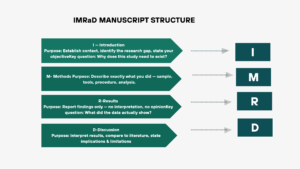
Structure your manuscript using the IMRaD format (Introduction, Methods, Results, and Discussion), which is the gold standard for empirical papers in Q1 journals. Your introduction must identify a clear research gap. Your methods must be replicable and sufficiently detailed for peer scrutiny. Your results must be presented without interpretation — that belongs in the discussion. And your discussion must go beyond summarising results to interpreting, contextualising, and positioning your findings within the broader literature.
Navigate peer review with strategy, not anxiety
Peer review helps researchers improve their work through reviewer feedback. The majority of papers published in Q1 journals went through at least one round of major revisions. Receiving a “Major Revision” decision is not rejection; it is an invitation to improve and resubmit. The key is to treat every reviewer comment as a legitimate concern, even if you disagree with it and to respond with a detailed, structured rebuttal letter.
Example: Give a response to the reviewers like“”We appreciate this important observation. After careful consideration, we respectfully maintain our original position because… [cite evidence]. We have added a sentence to the discussion section (p. 14, line 6) to clarify this.” Never respond to a reviewer comment with “We disagree.” Even when you believe the reviewer is wrong.
Optimise for post-acceptance visibility
Publication is only the beginning; visibility creates impact. A manuscript that no one reads loses its impact. Once accepted, invest in three areas: keyword optimisation (ensure your title and abstract contain the exact search terms your target audience uses), open-access options (many Q1 journals offer hybrid OA that dramatically increases downloads and citations), and active dissemination through ResearchGate, Google Scholar, and your institutional repository.
Conclusion:
Publishing in a Q1 journal is not only for the top researchers at top universities. It is achievable for any researcher who approaches the process strategically. Choosing the right journal before writing, structuring the manuscript to the journal’s identity, and treating peer review as a collaborative conversation rather than a verdict. The roadmap is clear.Start with one journal. Read five of its papers. Align your manuscript. Submit with a strong cover letter. Respond to every review with rigour and respect.