
Scopus Q1 vs Q2 Journals: Which One Should You Target and Why?
Choosing between a Scopus Q1 and Q2 journal is one of the biggest tasks a researcher faces before submission. The right choice depends on your career stage, research impact, and publication goals — and getting it wrong can cost you months of wasted review time.
What Do Q1 and Q2 Actually Mean?
Scopus journals are ranked into quartiles — Q1, Q2, Q3, and Q4 — based on their SCImago Journal Rank (SJR) score within a specific subject field. A Q1-ranked journal has the top 25% of all journals in its category. Q2 covers the next 25%, from the 26th to the 50th percentile.
Crucially, quartile rankings are subject-specific. A journal can be Q1 in one field and Q2 in another, depending on where it sits relative to other journals in each category. This means the ranking reflects competitive position rather than an absolute measure of quality. A journal with a modest SJR score can still be Q1 in a niche field with fewer competing titles — which is why checking the ranking within your exact subject category matters far more than looking at the SJR number in isolation.
A Practical Submission Roadmap
Most successful researchers follow a tiered submission strategy rather than targeting a single quartile. Here is how a practical roadmap looks:
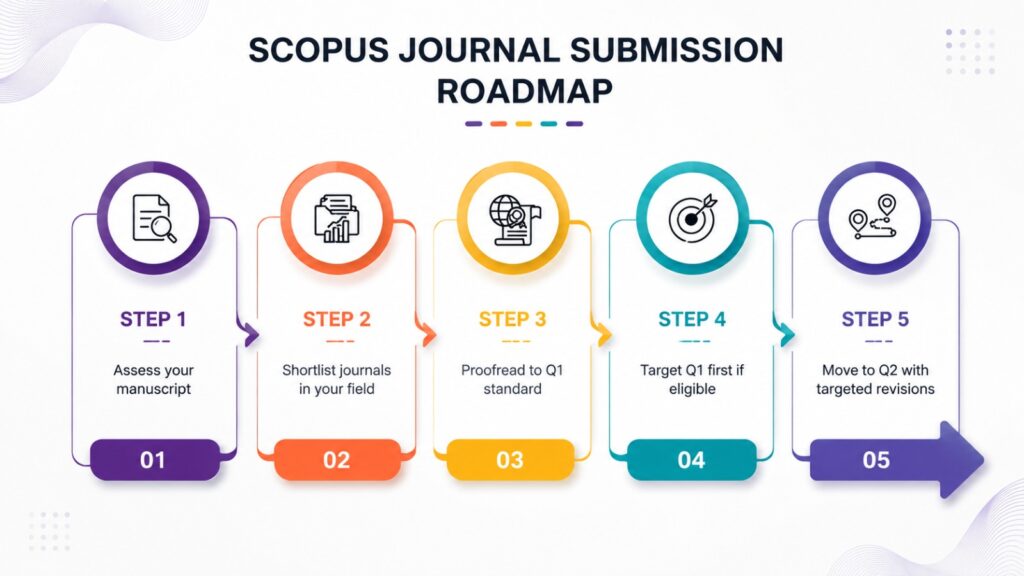
Step 1 — Assess your manuscript. Evaluate your findings objectively. Is this incremental or breakthrough research? Incremental improvements typically suit Q2; novel, field-shifting findings suit Q1.
Step 2 — Shortlist journals in your field. Use Scopus journal search or SCImago to identify 3–5 journals. Note their scope, quartile, acceptance rate, and average review timeline.
Step 3 — Proofread to Q1 standard regardless. Whether targeting Q1 or Q2, your manuscript must meet the highest language standard. Q2 journals still reject for language issues. Professional proofreading is essential at this stage.
Step 4 — Target Q1 first if eligible. Submit to your highest-ranked target first. If rejected, reviewer feedback often guides you toward a better-fit Q2 journal without major revision.
Step 5 — Move to Q2 with targeted revisions. If Q1 does not proceed, revise based on reviewer comments and resubmit to a shortlisted Q2 journal. Adjust scope framing to match the new journal’s focus.
Tip to remember: Check the Acceptance Rate, Not Just the Quartile
The researchers consistently overlook the acceptance rate. Two Q1 journals in the same field can have vastly different acceptance rates — one at 8% and another at 22%. A manuscript that is genuinely strong but narrowly specialised may stand a better chance at a Q1 journal with a broader scope and a higher acceptance rate than at a prestigious but hyper-selective title. Similarly, some Q2 journals have acceptance rates below 15%, making them just as competitive as their Q1 counterparts. Always cross-reference the quartile ranking with the acceptance rate data before finalising your submission target. This single step can save you a full review cycle.
For Example:
Consider a PhD researcher in environmental engineering who has completed a study on microplastic retention in constructed wetlands. The findings are solid and methodologically rigorous, but represent an incremental advance rather than a paradigm shift. She shortlists five journals using SCImago, identifying two Q1 titles and three Q2 titles within the environmental science category.
The first Q1 journal has an acceptance rate of 9% and explicitly prioritises high-impact global studies. The second Q1 journal, Applied Environmental Technology, has a 19% acceptance rate — a much stronger fit for her applied, site-specific work. She submits to the second Q1 journal first. After eight weeks, she received a revise-and-resubmit with constructive feedback on her statistical analysis. She addresses the comments, strengthens her discussion section, and resubmits. The paper is accepted.
So here, it clearly seems that not Q1 is always within reach, but that targeting the right Q1 journal — rather than the most prestigious one — gave her a realistic pathway, and the researcher might have skipped and defaulted straight to Q2.
Does Journal Quartile Affect Proofreading Requirements?
Q1 journals apply stricter editorial screening before manuscripts reach peer review. Language quality, clarity of expression, and formatting consistency are all evaluated at the desk review stage.
Q2 journals are more forgiving of minor imperfections but still expect publication-ready English. Manuscripts with grammar errors, unclear sentence structure, or inconsistent terminology are rejected at both levels.
Conclusion
Both Scopus Q1 and Q2 journals offer legitimate, internationally recognised publication pathways. The right choice depends on your career stage, the nature of your findings, and your submission timeline — not a blanket assumption that Q1 is always better.
What remains constant across both quartiles is the need for a professionally proofread, clearly written manuscript. Language quality is the single most controllable factor in your acceptance chances — and the one most researchers consistently underestimate. Fix the language first, then choose the journal. That order matters more than most researchers realise.